
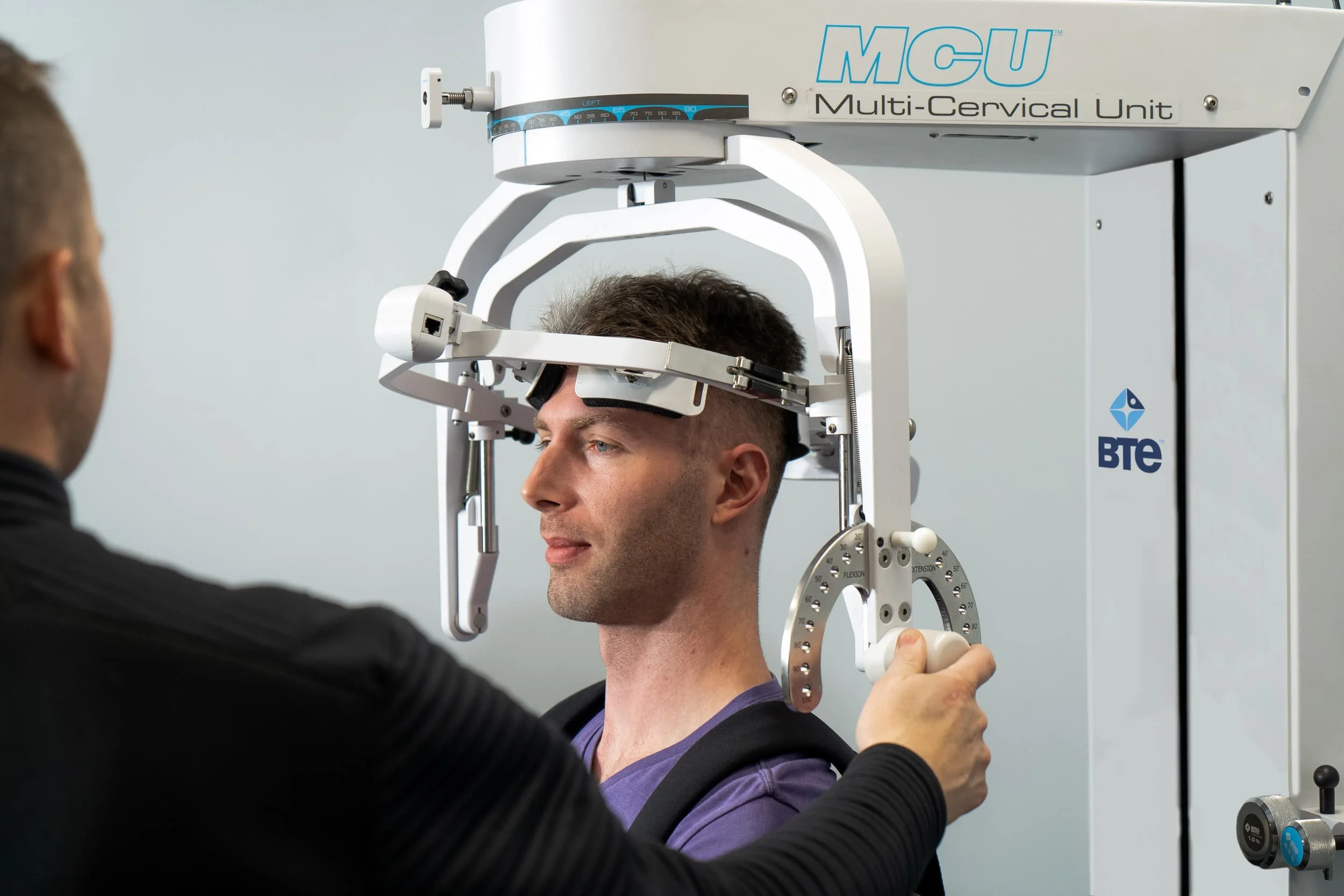
Multi-Cervical Unit (MCU) Neck Testing in Denver
Most people have some idea how strong their legs, arms, or core are, but almost nobody knows how strong their neck is.
At Studholme Chiropractic, our Multi Cervical Unit, or MCU, allows us to objectively measure how your neck moves and how much force it can produce in several directions.
Those measurements give us a starting point. We can identify meaningful strength or movement differences, build your rehabilitation around what we find, and retest to see whether your neck is actually getting stronger.
The goal is not to collect more numbers. It is to use the right information at the right time to build a stronger, more capable neck.
What Is a Multi-Cervical Unit?
A Multi Cervical Unit is a testing and rehabilitation system designed specifically for the neck.
The MCU measures cervical range of motion and isometric neck strength. It can also provide controlled resistance for neck strengthening during rehabilitation.
Instead of simply saying that your neck looks stiff or feels weak, we can measure how far it moves and how much force it produces.
Those measurements can then be compared over time to help guide your rehabilitation and track progress.
Pain alone does not tell us enough about what your neck needs.
One person may have limited movement. Another may move well but lack strength or endurance. Someone else may be strong in most directions but have a meaningful difference in one direction.
Two people can report similar neck pain and have very different strength profiles, which means they may need very different rehabilitation plans. Sometimes mobility is the problem. Sometimes the neck already moves well and simply needs more capacity. Measuring both helps us determine where you are starting and what may need to improve.
Just as importantly, we can retest. If we are asking you to strengthen your neck, we should be able to measure whether it is actually getting stronger.
Why Measure Neck Strength?
What the MCU Measures
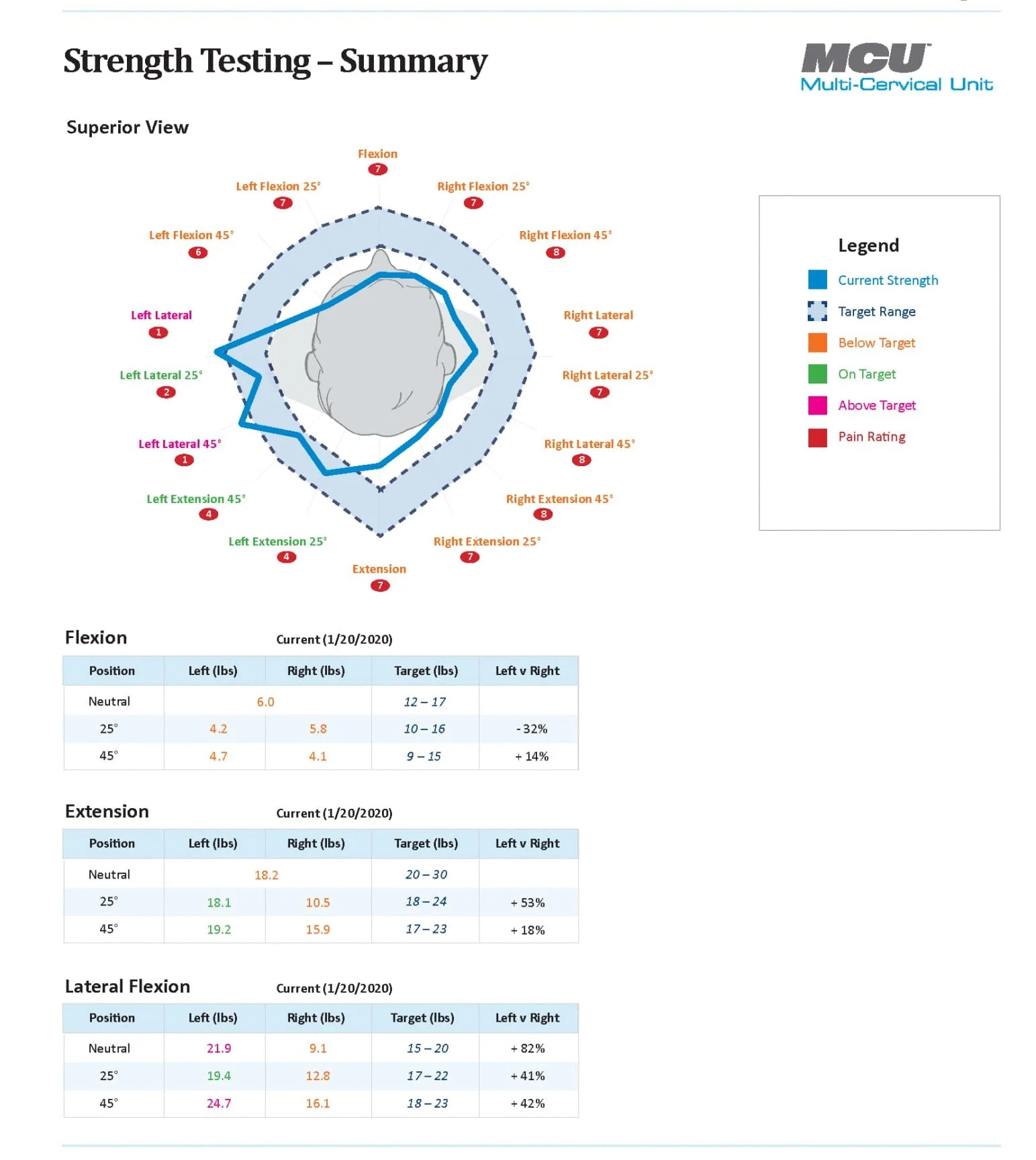
Neck range of motion: The MCU measures how far your neck moves in different directions, including flexion, extension, side bending, and rotation. This gives us an objective starting point rather than relying only on a visual estimate of how your neck moves.
Neck strength: The MCU measures how much force your neck can produce during isometric testing. This allows us to quantify strength rather than relying only on whether the neck feels strong or weak during a manual examination.
Differences between directions: We can compare how your neck performs from one direction to another. For example, we may find that rotation or side bending is stronger in one direction than the other, or that flexion and extension strength differ more than expected. Those findings can help make your rehabilitation more specific.
Change over time: One of the biggest benefits of objective testing is that we can repeat it. Your initial results establish a baseline. Later testing allows us to see whether range of motion and strength are actually changing as rehabilitation progresses.
Who Can Benefit from Neck Strength Testing?
MCU testing may be useful when we need more information about how your neck moves, produces force, or tolerates activity. We commonly consider it for people with:
Recurring neck pain
Chronic neck stiffness
Previous whiplash injuries after appropriate medical evaluation
Neck weakness or poor endurance
Shoulder symptoms that may involve the neck
Difficulty returning to activity after a neck injury
Desk or work demands that repeatedly fatigue the neck
Sports that place repeated demands on head and neck control
A desire to establish an objective neck strength baseline
Athletes in sports such as football, hockey, rugby, lacrosse, cycling, climbing, martial arts, and other activities may also benefit from knowing how their neck performs before building a strengthening program.
Testing is not automatically appropriate for every person. Your history and examination determine whether MCU testing makes sense for you.
What A Session Looks Like
Testing is controlled and performed within a range that is appropriate for you.
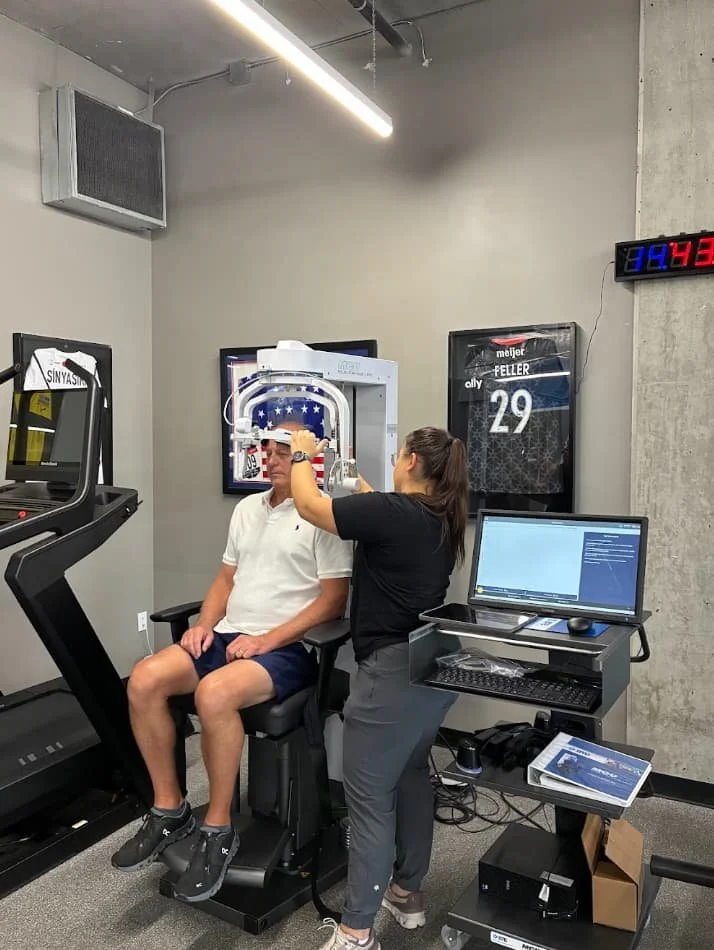
Setup: We adjust the MCU to your body and position you securely in the unit. This allows us to isolate neck movement and strength more consistently.
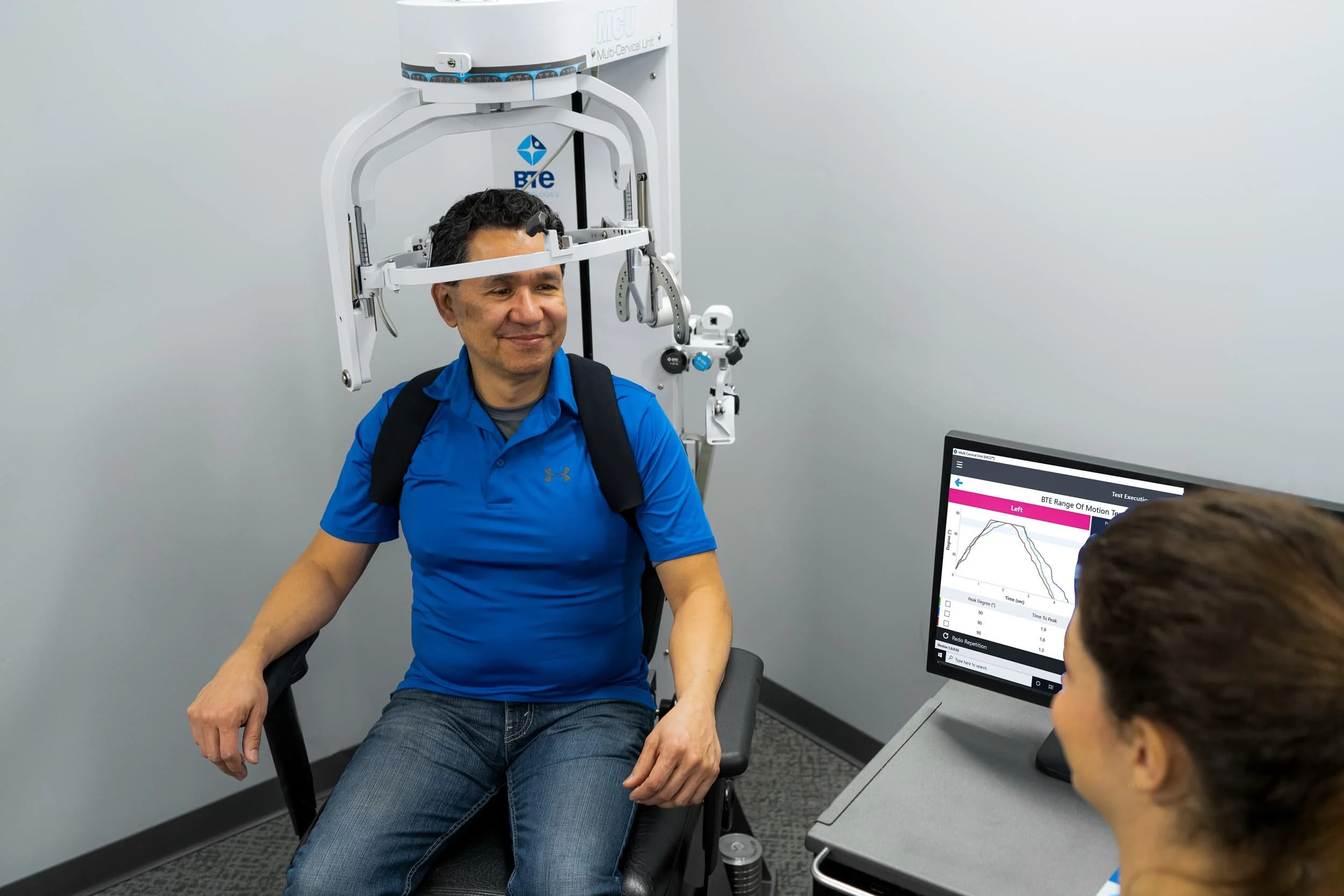
Range of motion testing: You move your neck through different directions while the system records your range of motion.
Strength testing: You push against the unit without moving your neck while it measures the force you produce. We can test multiple directions based on what your evaluation shows we need to measure.
Review your results: We walk you through the measurements and explain what they mean. You can see where you are starting, where meaningful differences may exist, and how those findings fit with your symptoms and goals.
Build your rehabilitation plan: Your results help determine where strengthening should begin and which directions need the most attention. Your exercises are coached with you in the clinic and filmed through SparkMotion so you know exactly what to do at home.
Retest: We repeat testing to see whether the neck is actually getting stronger rather than relying only on whether it feels better.
Measured versus estimated neck strength
| Clinical neck assessment | Multi-Cervical Unit testing | |
|---|---|---|
| Strength | Graded manually during examination from 0 to 5 | Force is objectively measured in the directions tested |
| Range of motion | Observed or measured with separate tools | Range of motion is recorded by the system |
| Side-to-side comparison | Approximate | Differences can be quantified and compared |
| Tracking progress | Based on symptoms | Repeat testing provides numbers to compare with your baseline |
| Rehabilitation | Varies by provider | Built around your evaluation, goals, and measurable findings |
The MCU does not replace a clinical examination. It adds objective information to your history, physical examination, symptoms, and response to activity.
Can the Multi Cervical Unit also strengthen the neck?
Yes. The MCU is not only a testing system. It can also be used for controlled neck strengthening. Depending on what your testing shows, we can progressively train the neck against resistance in different directions. That may include improving:
Neck Flexion strength
Neck Extension strength
Neck Side bending strength
Neck Rotation strength
Neck endurance
Control through different ranges of neck motion
The resistance can be progressed as your neck becomes stronger and better able to tolerate load. We can then retest to see whether those changes are showing up objectively.
How MCU testing fits into your care
We do not build your treatment plan around the MCU. We build it around you.
Your first visit at Studholme Chiropractic is approximately two hours and includes a full functional evaluation. We combine your history and physical examination with objective testing when it helps answer a clinical question. Follow up visits are one hour and combine hands on treatment with one on one rehabilitation. Your care may include:
Hands on treatment
Progressive neck strengthening
Shoulder and upper back strengthening
Movement and endurance training
Multi Cervical Unit rehabilitation
Filmed home exercises through SparkMotion
Class IV laser therapy when appropriate
Dynamic Taping when appropriate
Retesting to track progress
No single test gives us the entire answer.
We combine your MCU measurements with your symptoms, examination, activity demands, and goals to build a clearer picture of what your neck needs.
Learn more about our neck pain treatment in Denver.
Why people come to us for neck strength testing
Most people have never had their neck strength objectively measured. Many of our patients come to us after repeatedly treating how their neck feels without ever determining how strong it actually is.
Some find us through word of mouth, while others are referred by healthcare providers, coaches, or trainers who want a more detailed evaluation.
Our approach combines a two hour functional evaluation, objective movement and strength testing, hands on treatment, one on one rehabilitation, and retesting to track progress.
Dr. Nick Studholme has worked with athletes and active adults in Denver since 2000. He is certified in Advanced Muscle Integration Technique and co founded SparkMotion, a movement assessment and rehabilitation platform used in high performance sports settings.
Technology is only useful when it changes a clinical decision.
We use MCU testing to answer specific questions, establish a baseline, guide rehabilitation, and measure progress rather than collecting numbers simply because we can.
We are also honest about what belongs in our office. If your history or examination suggests that imaging, medical evaluation, or specialist care is the better next step, we will tell you and help direct you to the appropriate provider.

Multi-Cervical Unit Testing FAQs
-
A Multi Cervical Unit, or MCU, is a system used to objectively measure neck range of motion and strength. It can also provide controlled resistance for neck strengthening during rehabilitation.
-
MCU testing measures how much force your neck can produce during isometric contractions in different directions. We can use those measurements to establish a baseline, identify meaningful differences, guide rehabilitation, and retest later.
-
Testing should not require you to push through significant pain. We select the testing based on your history, examination, symptoms, and current tolerance. If a direction or test is not appropriate for you, we modify or avoid it.
-
Neck strength testing may be helpful for people with recurring neck pain, neck weakness or fatigue, previous neck injuries, shoulder symptoms that may involve the neck, or sports and activities that place repeated demand on head and neck control.
It can also be useful for someone who simply wants an objective baseline before beginning a neck strengthening program. Your evaluation determines whether testing is appropriate for you.
-
Yes. The Multi Cervical Unit can provide resistance for controlled neck exercise as well as measure strength and range of motion. This allows testing and rehabilitation to work together.
-
No. The MCU is one tool within a larger rehabilitation plan. Your care may also include hands on treatment, shoulder and upper back strengthening, movement training, home exercises, and other treatment tools based on what your evaluation shows.
-
Because pain alone does not tell us how strong your neck is. Objective testing gives us a starting point and allows us to determine whether the strengthening you are doing is actually producing measurable change.
Find out how strong your neck is
If you have recurring neck pain, fatigue, stiffness, a previous neck injury, or simply want to know how your neck performs, we can establish an objective starting point and build a plan around what we find.
The goal is not simply to make your neck feel better temporarily. It is to use the right tools at the right time to help your neck become stronger, more capable, and better prepared for the demands you place on it.